
Sign up here to subscribe to the Grower2grower Ezine. Every two weeks you will receive new articles, specific to the protected cropping industry, informing you of industry news and events straight to your inbox.
30
Aug 2021
Aug 2021
Ihemp Summit Expo (May 2021)
By Dr Mike Nichols
The 2021 IHEMP EXPO was held at the Events Centre, Rotorua from 19-22 May 2021. It was organised by NZ Hemp Industries Association (NZHIA) and comprised an afternoon visit to Scion, followed by 2 full days of presentations, and a Public Day for local residents to listen to some seminars, and to view the trade exhibits.
Following a Mihi Whakatau we were told by the mayor of Rotorua (Steve Chadwick) a former MP and Cabinet member in an earlier labour government. How happy she was to welcome us, as we were the first international conference to be held in Rotorua since Covid, particularly the delegates from Australia.
The welcome from Richard Barge (Chairman of NZHIA) was followed by the Keynote address by Hadleigh Smith from Merino NZ, who emphasised the possible advantages of going it alone with a specialised product, rather than linking with a bigger organisation (e.g., NZ Wool Board). Of, course, currently any natural fibre is increasingly popular world-wide because of its biodegradability compared with artificial fibres.
Michael Haynes (Medsafe) then presented an overview of the current licencing, framework and application activities required to grow industrial hemp, while Manu Caddie (Medical cannabis Council) spoke on the practical implications of the current regulations for both medicinal and industrial cannabis. This was followed by Simon Yarrow (Callaghan Innovation) who presented a paper on hemp industry updateable road maps.
The recently opened travel bubble between Australia and New Zealand allowed two speakers from Australia to be physically present rather than by zoom. Tim Schmidt is the Chair of the Australian Hemp Council, and he spoke on recent trends in food and fibre in Tasmania, while Andi Lucas told us about the plans for the next Australian Hemp Conference, to be held in Launceston, Tasmania next year, then Pat English (Tamona Consulting) addressed the meeting on the integrated roles of government, the regulators, research and industry in internationalisation.
After lunch the session highlighted industry experiences.
First up was Matthew Johnson (Hemp Connect) who spoke on food issues on growing hemp from seed. He was followed by Leigh Gibbs (Cosmetic NZ), who described how to get started into cosmetics, and the role of Cosmetics NZ. Jo Townsend (Midlands Seeds) brough us back to earth with a paper on cultivar selection for food crops, and she was followed by Owen Darby (Meraki Natural) who described the use of hemp for bioremediation of soils polluted with heavy metals, and the possible extraction from the hemp of some high value metals. Tanya Simmonds (Hempseed Holdings) then presented an account of the work of Mack McIntosh, (the “godfather” of hemp growing in New Zealand). It was then the turn of three ladies from Hinemaia Hemp o Te Waimana to describe their efforts to grow hemp, and their intention to use it for producing low-cost housing for Ngai Tuhoe iwi. Inspirational!
After afternoon tea the next presentation was by Kirsty Harkness (Mount Base) who described her work to grow hemp between rows of wine grapes in Marlborough. My immediate thoughts were “no way”, but she was able to demonstrate that not only was yield not reduced, but the quality of the wine had been enhanced. This appears to have been due to the pollen from the hemp landing on the grape berries and feeding the yeast. Nigal Slaughter (Ligar Polymers) then suggested that the future for hemp was in separating the many different chemicals within hemp for product development. eg removing THC for example would open up considerable opportunities to use hemp chemicals for flavouring or for specialised medicinal purposes. Cannabis is a cornucopia of valuable chemicals, which currently in New Zealand are restricted due to the current restrictive regulations. Peta Fraser (NZTE) then showed how exporting could be assisted by using NZTE, and the day finished by a presentation by Dr Nick Hunt (Next Corporation), who suggested what might be achieved by 2025 with just a few minor changes in the current regulations!!
The following day commenced with an enthusiastic presentation by Jo Say of the Hemp Building Association of NZ who explained why hemp should replace concrete as a building material. Chiefly sustainability and lightness, as cost is not dissimilar to yhat of other building materials. It is clearly a material to seriously consider in the future, once there is an adequate supply of hemp available. Fireproof, and with high insultation characteristics it has a lot of potential. Note: in fact, my nephew in England has recently built a straw house using similar principals. It has tremendous insulation properties both in the winter, and the summer. Manu Rastogi (Kathmandu) then described how he would like to incorporate Hemp fibre into his wool mixes. He was followed by a scientific presentation by Johanna Steynaert (Lincoln Agritech) on how to build resilience to the production of hemp by using the naturally occurring soil biology.
Functional Foods and wellness were the topic of Samantha Gray (BioEquitas and Natural Health Products), and she was followed by Mark Lucas (from Cannasouth) who spoke on Medicinal cannabis production and research. Florian Graichen (Scion) then spoke on ambitions, the scientific requirements and New Zealand's capabilities. Dr Parmijit Randhawa (Greenlab, Lincoln) then emphasised how complex the growing of cannabis was for both medicines, or food or fibre.
The final session of the conference was all about regeneration with an introduction by Igor Botelho, (Brazil) and a zoom presentation from USA by Ryland Engelhart (the founder of “Kiss the Ground”).
To me the take home message was that New Zealand must move away from too much dependence on a few sectors of agriculture/horticulture, eg dairy and sheep (or in horticulture kiwifruit and apples), and to diversify into a number of different products. Hemp is just one possibility but has a wide range potential uses and of products. Two which come immediately to mind are:
1. CBD for its ability to provide wellness. In the USA (for example) it is available in a wide range of products, but because in New Zealand it is included in the medicines act it is treated like a controlled substance, even though it has no psychoactive properties.
2. Hemp as a building material has potential, but currently is mainly imported because hemp production in New Zealand is insufficient to provide enough. A chicken and egg situation.
Photos.
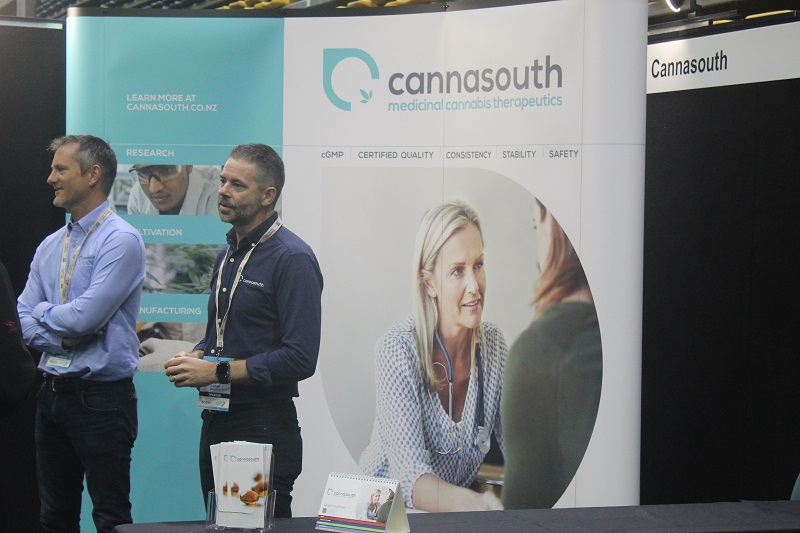
Canna South was the only medicinal cannabis company with an exhibit.
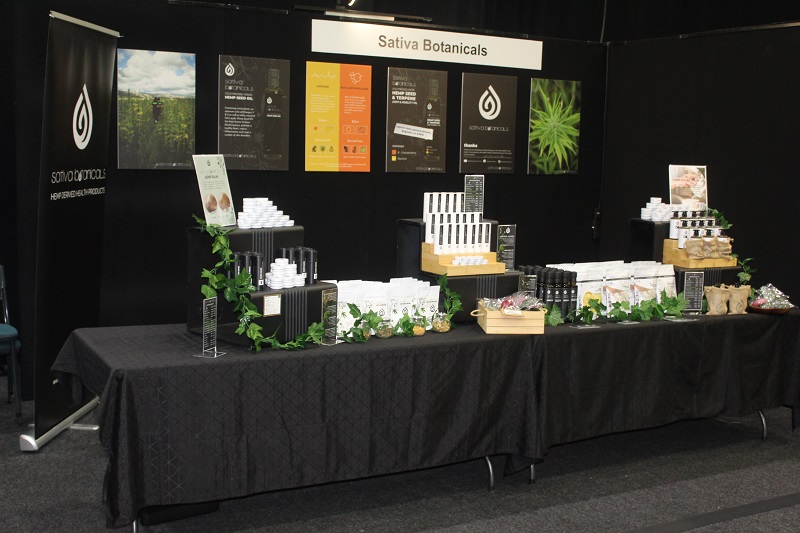

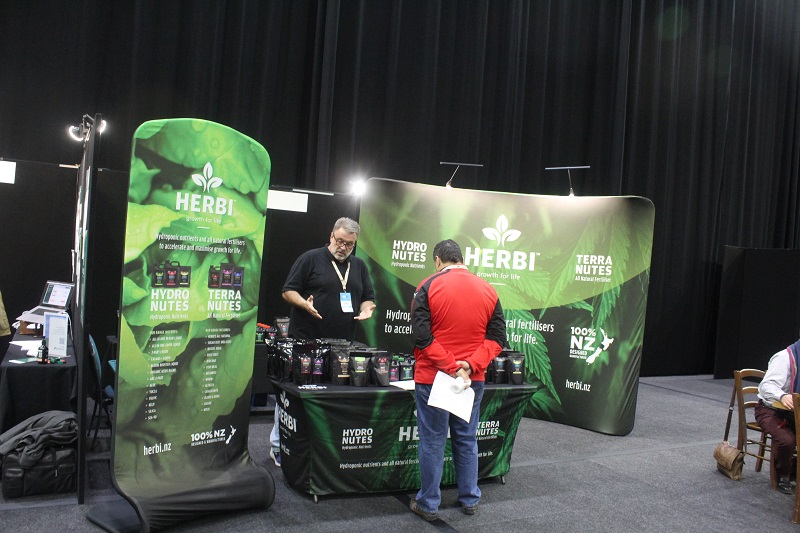
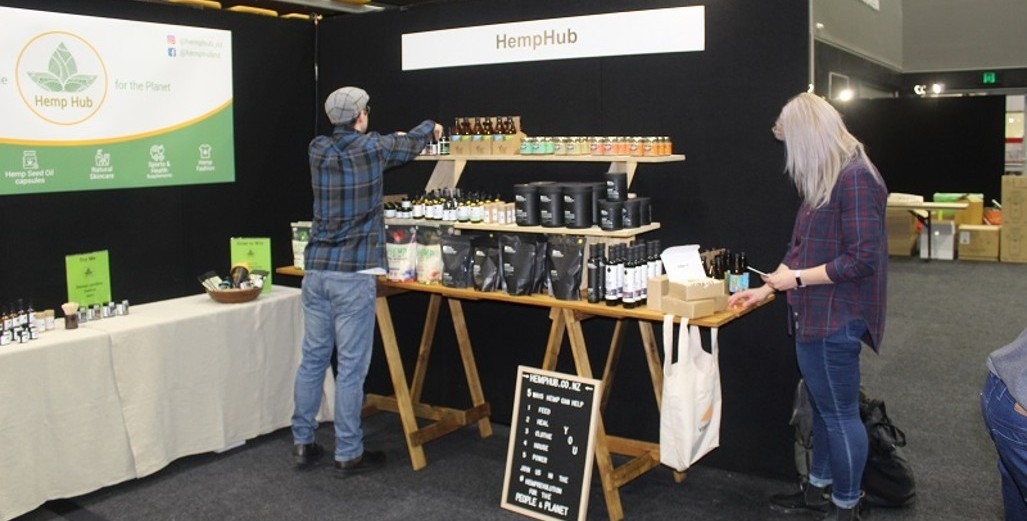
Selling hemp products is becoming an important industry.
I appreciate your comments. Please feel free to comment on the grower2grower Facebook page:
https://www.facebook.com/StefanGrower2grower/
CLASSIFIED






Subscribe to our E-Zine
More
From This Category
April 20, 2026
IFPA Produce Executive Program returning to Auckland
Week-long fully residential program environment facilitates deep level collaboration, learning and engagement
April 20, 2026
Delphy Academy Training – Fertigation in Horticulture
In this online training (English spoken) you will learn about the chemical aspects of nutrients and fertigation, how to read an analysis, and how to make adjustments to the fertilizer recipe. Calculation of your own A and B tank filling from a recipe. The uptake of water and nutrients by the plant and the relationship with pH and EC.
April 7, 2026
The 2026 Hydroponic Farmers Federation Conference (Melbourne) Update
Fast approaching event: Final reminder to register for this important event.
March 23, 2026
Bringing the Sector Together: Covered Cropping NZ Launches
Greater collaboration, stronger representation, and better use of levy funding sit behind the new joint approach from Tomatoes New Zealand and Vegetables New Zealand Incorporated. There has been a call, for several years, that TNZ and VNZI should work together more closely as there are so many similarities amongst the greenhouse sector, including the growers themselves.
March 23, 2026
Energy Under Pressure: Growers Invited to Pukekohe Open Day
Join Tomatoes New Zealand and Vegetables New Zealand on 14 May for site visits and supplier discussions showcasing real-world energy solutions, cost savings, and practical pathways for the season ahead.
March 10, 2026
The 2026 Hydroponic Farmers Federation Conference (Melbourne)
2026 program has been carefully designed to address the key issues currently facing hydroponic growers
CLASSIFIED