
Sign up here to subscribe to the Grower2grower Ezine. Every two weeks you will receive new articles, specific to the protected cropping industry, informing you of industry news and events straight to your inbox.
3
Dec 2024
Dec 2024
An observation about Chlorosis effecting Tomato Plants.
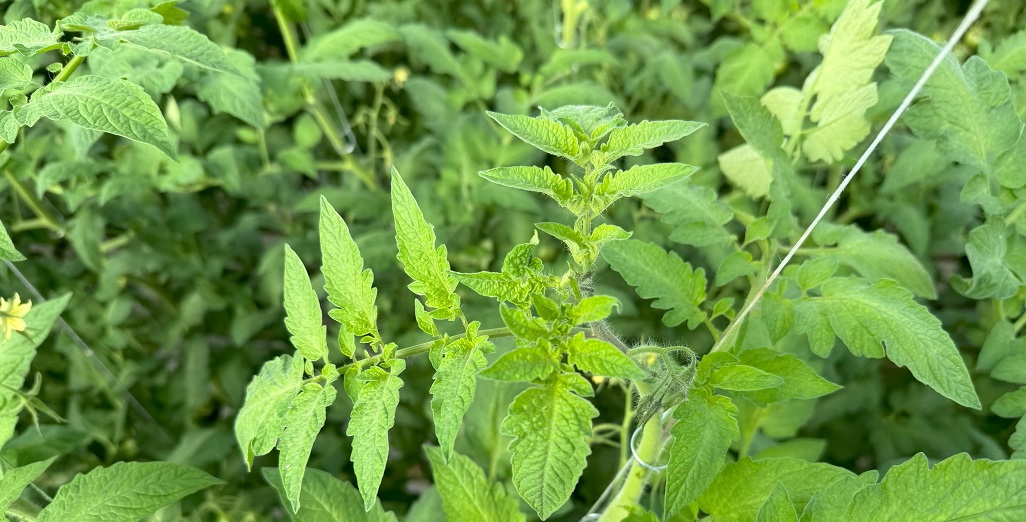
Has applying a coating contributed to an increased uptake in nutrient and were we too slow to react?
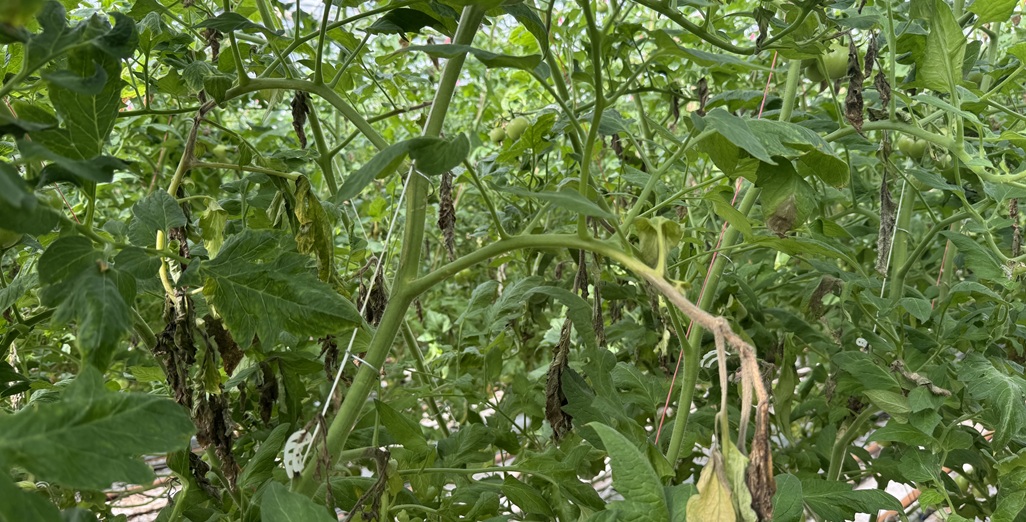
Due to the issues with PepMV and the posed risk from ToBRFV, I currently carry out my tomato crop consultancy from my office, however I still visit several of my customers. Recently I noticed a rapid change in one of those crops with what I determine on the Grower2Grower worry chart as a mild issue of Leaf Chlorosis. This is nothing new as Chlorosis is common and generally a very easy fix with nutrient management.
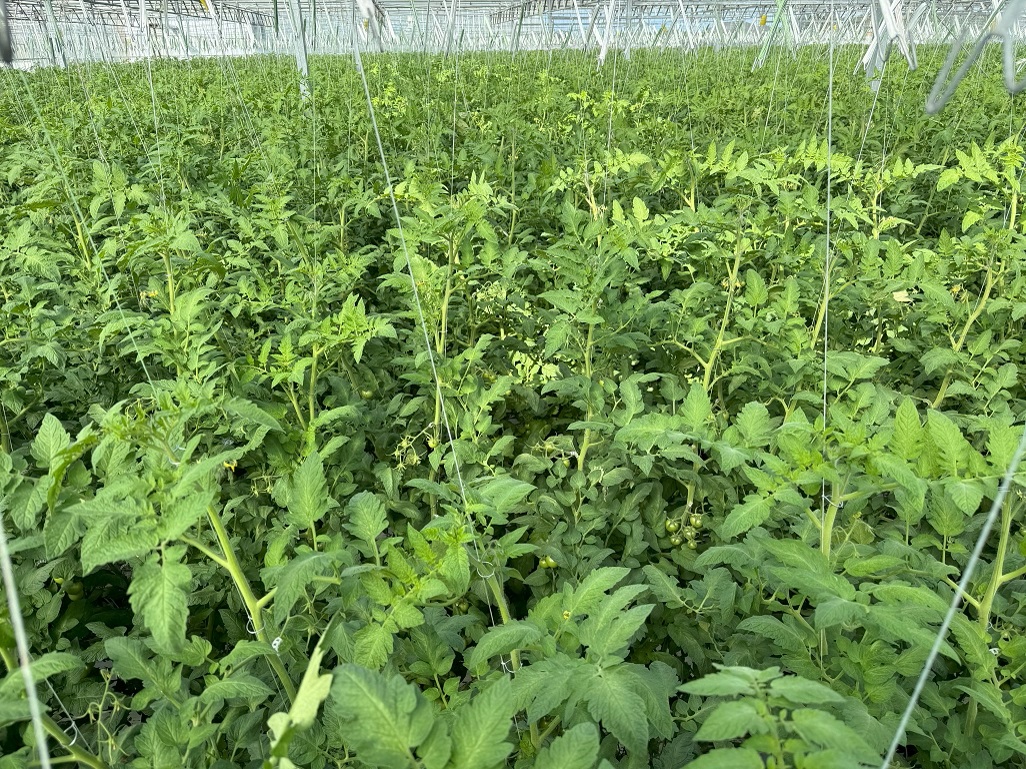
On observation I made was how evenly spread the Chlorosis in this particular greenhouse. Sometimes it may be patchy, however but this was evenly spread through two different varieties. I expect to see Chlorosis as light levels increase and the plants growth increases as it is hungry for certain elements.
It may be a total coincidence but the Chlorosis has appeared a few weeks after a diffused coating was applied to the greenhouse. Please note that I believe the best decision for this crop going into summer is to have a diffused coating applied, the benefits from the coatings will be numerous. We are able to quickly deal with the Chlorosis, so this is not an issue at all, it is just perked my curiosity.
Below is a link to a research paper regarding continuous light on tomato plants and the effect this has on Chlorosis. Even though it is based on artificial lights, when you apply a diffused coating the spread of light will change. If the blue and red-light wavelength levels are different then possibly this may have contributed to an increased change in growth contributing to the Chlorosis, or and a big or, it may just have something to do with the natural increase in temperature, day length/light levels and the age of the crop. So, no conclusions just questions.
If you have a noticed a similar pattern when applying a coating, I would be very interested to hear from you. Please email stefan@grower2grower.co.nz
Leaf chlorosis, epinasty, carbohydrate contents and growth of tomato show different responses to the red/blue wavelength ratio under continuous light
To read research article click on the link below. Source Science Direct
https://www.sciencedirect.com/science/article/pii/S0981942819302396
Abstract
The induction of leaf injuries, including leaf chlorosis and epinasty, by continuous light in tomato plants is one of the most interesting and mysterious phenomena regarding plant interactions with light, the mechanism of which has not yet been revealed. To gain further insights into this particular response of tomato plants, we cultivated tomato seedlings (Solanum lycopersicum cv. Momotaro) for 14 days under continuous light with different ratios of red and blue light and compared their performance to those grown under continuous or 14/10-h photoperiodic white light using novel methods to quantitatively evaluate the level of leaf chlorosis and epinasty. Continuous monochromatic blue light induced severe chlorosis but almost completely alleviated epinasty in tomato leaf. In contrast, continuous monochromatic red light caused a lower level of leaf chlorosis but very severe epinasty. The combination of red and blue light at different ratios significantly reduced both leaf chlorosis and epinasty under continuous light condition. Carbohydrate contents showed no correlation with leaf chlorosis, while glucose and fructose contents showed correlations with the petiole and leaflet curvatures. Histochemical staining with 3,3′-diaminobenzidine and nitro blue tetrazodium chloride also did not reveal any significant buildup of hydrogen peroxide and superoxide anion in monochromatic blue light treatment. Taken together, these results suggest that chlorosis and epinasty are two distinctive leaf injuries caused by continuous light that may follow very different mechanisms, and an overaccumulation of carbohydrates in the leaf may not be the main cause of continuous light-induced leaf chlorosis in tomato.
CLASSIFIED







Photo
Gallery




Subscribe to our E-Zine
More
From This Category
August 11, 2026
Cucumber Grafting: Insurance Policy or Unnecessary Cost?
Grafting can provide a stronger root system and valuable insurance against root-zone problems – but it won’t protect the canopy from fungal disease.
July 27, 2026
Combating Leaf Mould and Powdery Mildew in Greenhouse Tomatoes 2026
It's been eight years since I first wrote about controlling leaf mould. While many of the principles still apply, growers now have more tools available, making it a good time to revisit what works and where disease management is heading.
July 27, 2026
GrowWise smart spectrum helps growers save energy or boost crop growth through automated spectrum optimization
“With just a few clicks, we achieved approximately 2% more light on the crop”
July 13, 2026
Why Botrytis has become such a challenge this winter
The objective is not to grow a vegetative crop or a weak generative crop. The objective is to grow a balanced crop with enough vigour to support the fruit load while maintaining healthy leaf quality.
July 13, 2026
Philips LED lighting enables precise winter growing at Truly Green Farms (Canada)
For Truly Green Farms, winter tomato production depends on having the right lighting system in place.
CLASSIFIED