

Sign up here to subscribe to the Grower2grower Ezine. Every two weeks you will receive new articles, specific to the protected cropping industry, informing you of industry news and events straight to your inbox.
13
May 2019
May 2019
Capsicums
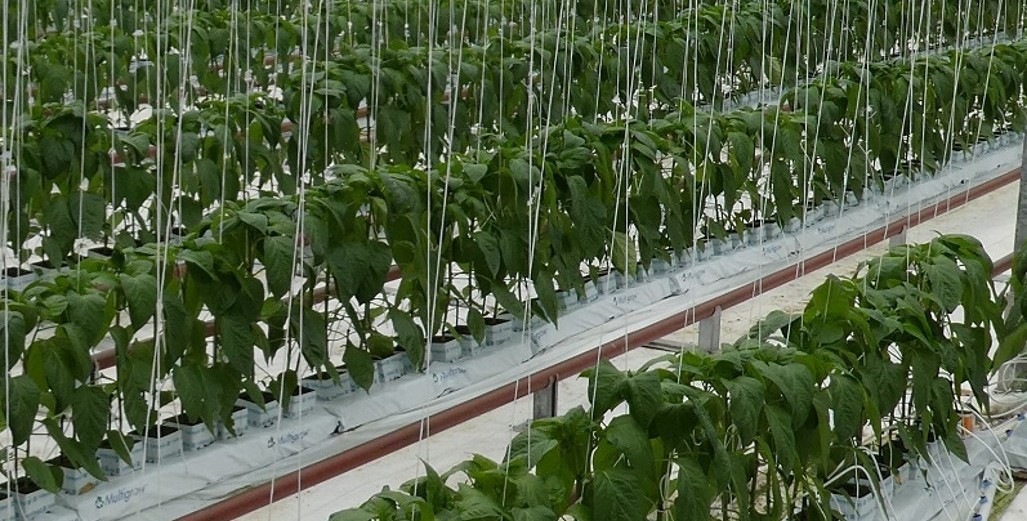
Fruit per m2 v light and temperature (part 2)
In the last edition of Grower2Grower I asked “if we have less fruit per m2 how much more speed/temperature can we gift the plant in late Autumn/Winter?” I believe there is an answer but since I am not a computer, and we don’t have the ‘perfect’ controls, the conclusion we make as growers is always going to be subjective. If I flip my question on its head, I would ask: at what temperatures, high or low will cause negative impacts on the plant’s productivity? Low temperatures will both slow production and potentially have detrimental health impacts on plants. High temperatures in relation to high fruit load and low light sum will also be counterproductive.
Capsicums:
I want to start with Capsicums, mainly because millions of young plants have either just been planted or are soon to be planted. Capsicums thrive in warm temperatures and are light sensitive. They are generally planted from April-July, with some smaller amounts planted outside of that window. I am not a capsicum specialist but have always been fascinated with the initial growth and first fruit set kept for harvesting by the grower. I have been taught that this plays a very important role in balancing a capsicum plant, which may determine the balance of the crop for the entire season. I am not sure how all growers determine which of their first flowers they will keep for their first set, but I believe there to be multiple factors which are used for consideration. Unlike tomatoes and cucumbers, capsicums are like watching a rather large bus go around a corner, things happen very slowly so if you make a mistake it takes longer to turn the bus around.
The first two leaves from each split is where the first fruits may be kept and encouraged to grow. I have even seen some growers leave the crown fruit or the flower at the split, but more often than not it is removed. In countries that plant in very low winter light levels they may wait until the third and fourth leaf, after the split, before they attempt to set fruit. This demonstrates how every environment is different and how you must adapt your growing conditions.
If you have been able to set the two flowers on both the 1st and 2nd leaf, after the split on each head, then these four-fruit become key for balancing the crop. I was advised that you should sacrifice one fruit, when it was golf ball sized, on the less vigorous stem (if you are a two headed system) and pick the first capsicum as a green on the corresponding stem, you can then leave the next two capsicums to change colour if that’s what you are picking, (Growers picking green will probably have a different fruit loading method). The significance is so you don’t overload the plant in low light and it still has the ability to set new fruit on the next leaf nodes that flowers are kept on (keep in generative mode). Crops that have a large first set with too many fruit per m2 followed by low light will possibly have fruit abortion on the leaf nodes they hoped to be there next picking set, therefore unbalancing the crop from a generative phase back to a vegetative phase. This can cause a delay in harvesting and a rather large loss of earnings.
With light, the determining factor, and temperature the driver, it is important at a young stage of a capsicum plants development that you are not cautious but realistic with your fruit set per m2. If you keep less fruit you could potentially run with a higher temperature and if you come into poor weather you have the ability to pull back on temperature, allowing the plant to hold onto the second set. If you do have good weather you can potentially gift more temperature and build speed into the plant.
Please feel free to let me know how you go about setting your capsicums at this time of year and the different factors that are involved for your growing operation. Seed companies are most welcome to provide feedback. Let’s learn together.

I appreciate your comments. Please feel free to comment below or on the grower2grower Facebook page:
https://www.facebook.com/StefanGrower2grower/
Article Written by Stefan Vogrincic, Consultant, Grower2Grower
Article Edited by Marie Vogrincic, Editor, Grower2Grower
CLASSIFIED












Subscribe to our E-Zine
More
From This Category
March 10, 2026
Australia’s horticulture sector has delivered a year of record‑breaking performance
Highest production value to date of $18.4 billion, up 6% on the previous year.
March 10, 2026
Energy saving through screens
A combination of screen use, screen quality, greenhouse climate requirements, and greenhouse equipment.
March 10, 2026
Heating Uncertainty Leaves Greenhouse Growers Searching for Answers
Waste oil supply changes force growers to reconsider long-term heating options ahead of winter. Two weeks ago I was alerted that one of the major recycled waste oil suppliers, based in the Auckland region, will soon stop supplying greenhouse growers. For one of my customers this came as a significant shock, particularly given that notice was given that deliveries will cease in the coming months –

February 10, 2026
MG Group partners with The Gut Foundation
Growing a healthier New Zealand together

January 27, 2026
Protected Cropping, Weather Extremes And Growth Potential
Extreme weather again highlights the role of protected cropping. During last week’s deluge across the North Island, significant damage is expected across many outdoor crops. Onions lying on the ground and attempting to dry will be particularly vulnerable, with prolonged saturation likely to result in quality losses and storage issues.
CLASSIFIED