
Sign up here to subscribe to the Grower2grower Ezine. Every two weeks you will receive new articles, specific to the protected cropping industry, informing you of industry news and events straight to your inbox.
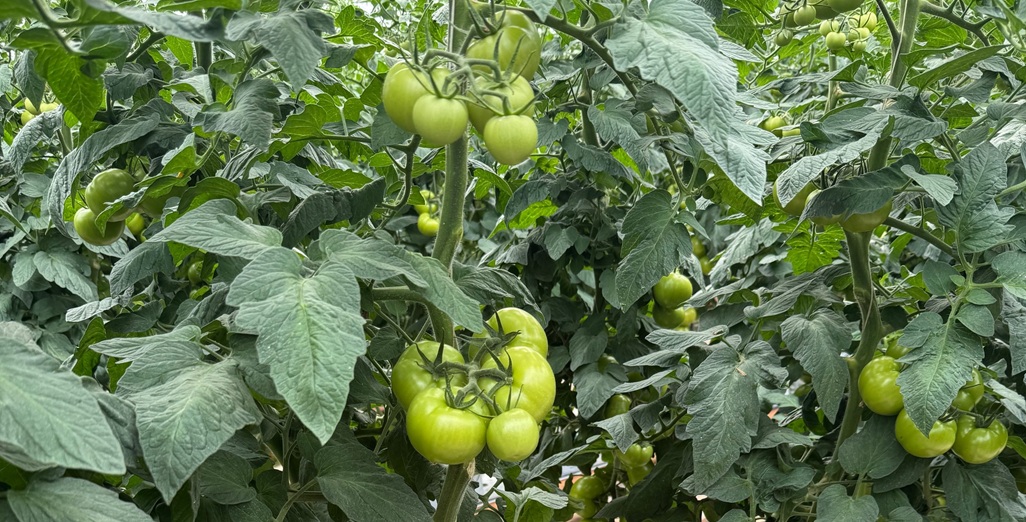
Research article: When transitioning from HPS lights to LEDs, the screen and heating strategies can rarely be directly copied from a previous HPS setup.
Switching to LED lighting significantly alters the greenhouse microclimate and therefore requires a different cultivation strategy.
The general understanding is that the yellowing of upper leaves and browning of leaf edges is mainly due to a lack of calcium or its transport disruption to the leaves’ outer cells. As calcium is transported passively to the plant with water, its availability depends on transpiration and sap flow rate.
Results from a trial in Lepaa, Finland, performed by Signify, Häme University of Applied Sciences and Aranet, indicate that calcium for some reason did not effectively reach the head of the plant causing tip burn, although water was absorbed and consumed. The crop was cultivated under a PPFD of 460 µmol/m²/s using a lighting mix of roughly 75% LEDs and 25% HPS. At these light levels, shifting from an HPS system to a hybrid or fully LED-based installation can dramatically alter the plant’s transpiration dynamics.
Tips to prevent tip burn
By installing sensors that enabled real-time monitoring on microclimate variations that affected sap flow, a few conclusions could be drawn to minimize or prevent tip burn.
- Optimize screen usage and heating pipes to ensure that the leaves maintain good water tension at night and transpire efficiently during the day,
- Create an active climate during daytime, where the entire plant transpires effectively by using grow pipes, ensuring sufficient temperature and good air circulation around the leaves, and preventing the relative humidity from rising too high.
- Heat the head of the plants by using energy screens or heating pipes installed higher up in the vegetation and promote air circulation to further enhance with vertical fans.
Plant water uptake during the season
In a two-year monitoring period in different greenhouses, it was observed that tip burn began to develop by mid-November and was at worst by late January. Although it is generally thought that evaporation and water uptake decrease in winter, measurements from Lepaa, Finland showed otherwise: the plants took up water steadily throughout the winter season, suggesting that although water is consumed, calcium for some reason does not effectively reach the head of the plant. To deepen our understanding, we installed sensors which helped understand the flow of water through the plant.
The sap flow sensors were attached to leaf petioles to provide detailed information about the transpiration and water uptake in different parts of the plant. The microclimate surrounding the leaves was monitored using sensors that measured air temperature, humidity, and leaf temperature.
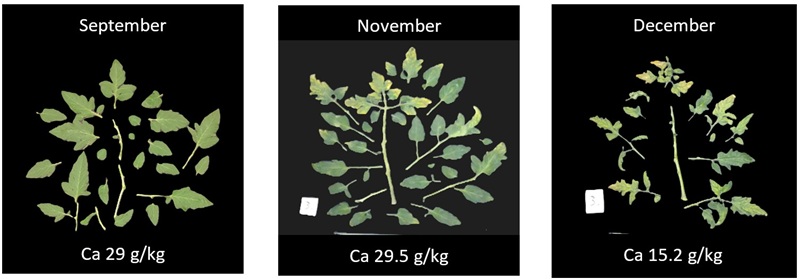
Tomato leaves in September, November and December. Each leaf is the 8th leaf counted from the top of the plant. Despite steady water uptake, the calcium fails to reach the plant head.
The effect of the microclimate
The sensors enabled real-time monitoring of how microclimate variations affected sap flow. For instance, at the end of September, the relative humidity in the upper canopy was higher than in the lower parts, and this situation only reversed at the beginning of December. High humidity slows down evaporation because it reduces the moisture gradient between the inside and outside of the stomata, making the surrounding air less effective at drawing water from the stomata. This slows down sap flow and calcium transport, thereby promoting the development of tip burn.
Effect of lighting on transpiration
When transitioning from HPS lights to LEDs, it can be assumed that transpiration slows down and water uptake decreases. In greenhouses where this switch has already been made, tip burn symptoms have either remained the same or, in some cases, increased, although the light itself is not the cause. The difference arises from the distinct ways the luminaires produce light and their impact on the canopy’s microclimate. The abundant heat radiation from HPS lights warms the top leaves and circulates air, promoting transpiration and sap flow. In LED-lit greenhouses, the top of the plant is often cooler and air circulation slower, which can decrease sap flow in the upper leaves.
The greenhouse uses a hybrid lighting setup, combining HPS (140 µmol/m²/s) and Philips LED toplighting (240 µmol/m²/s) combined with Philips LED interlighting in the middle of the canopy (80 µmol/m²/s). Sap flow sensors provided real-time data on how the lights’ on-off rhythm affected leaf transpiration. The graph below shows that when the HPS lights were turned off, sap flow in the upper leaves dropped significantly, but the sap flow rate in the lower leaves remained unaffected.
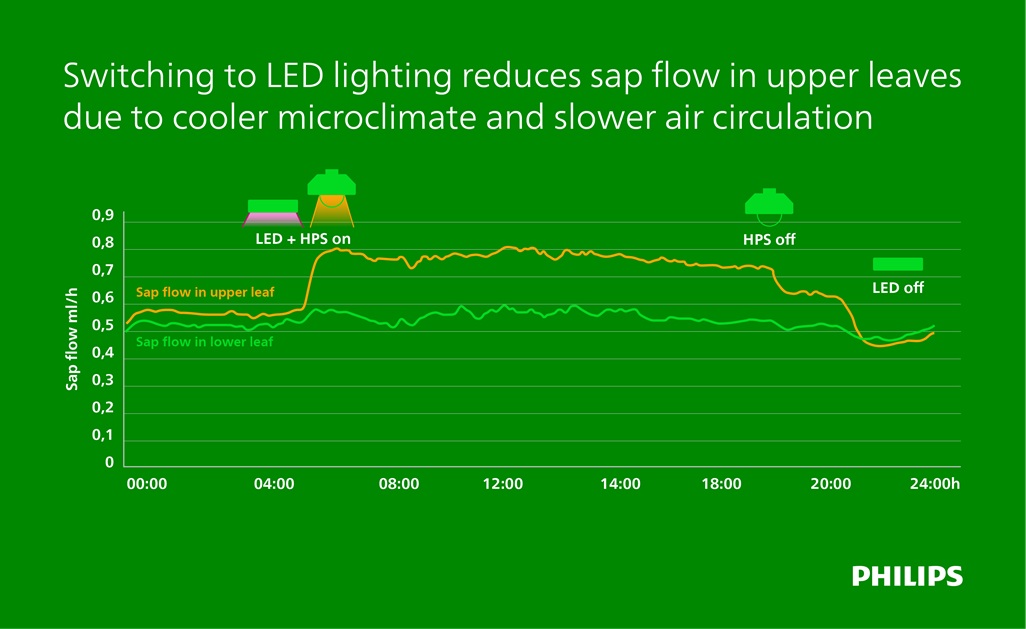
Sap flow rate on the 12th of November measured from a leaf in the upper canopy (orange) and lower canopy (green). Lights were switched on at 5:20. HPS 140 µmol/m2/s was switched off 19:20, and LED toplighting 240 µmol/m2/2 were switched off at 20:40.
Nighttime transpiration can prevent water from reaching the head
Early in the season, plants transpired heavily during the day and rested at night, until a noticeable change occurred in October. By late November, transpiration in the upper leaves decreased, while the lower leaves continued to transpire continuously, with little difference between day and night.
The continuous 24h transpiration in the lower leaves is linked to nighttime heating with the rail pipes. As the greenhouse temperature is being maintained by the rail pipes, the heat stimulates transpiration in the lower leaves. Additionally, dehumidification relies on the heat from the lower pipes, further increasing transpiration.
When the stomata of the lower leaves remain open throughout the night, sap flow and water uptake stay elevated, even though nighttime transpiration offers little benefit to the plant and may, in fact, be counterproductive. Allowing the stomata to close fully during dark hours can be more advantageous. One way to support this is by maintaining a lower rail-pipe temperature at night. This can be achieved by permitting slightly higher relative humidity—while keeping conditions dry enough to prevent fungal diseases—or by removing excess moisture through dehumidification rather than by increasing pipe temperature. Doing so prevents excessive transpiration in the lower leaves, enabling root pressure to move water and calcium more effectively toward the upper canopy and helping to reduce calcium deficiency and tip burn.
For further information, please contact:
Philips horticulture LED solutions by Signify
Daniela Damoiseaux – Global Marcom Manager
For further information, please contact:
Philips horticulture LED solutions by Signify
Daniela Damoiseaux – global marcom manager
Tel: +316 40578311
E-mail:Daniela.damoiseaux@signify.com
About Signify
Signify (Euronext: LIGHT) is the world leader in lighting for professionals and consumers and lighting for the Internet of Things. Our Philips products, Interact connected lighting systems and data-enabled services, deliver business value and transform life in homes, buildings and public spaces. In 2021, we had sales of EUR 6.9 billion, approximately 37,000 employees and a presence in over 70 countries. We unlock the extraordinary potential of light for brighter lives and a better world. We achieved carbon neutrality in 2020, have been in the Dow Jones Sustainability World Index since our IPO for six consecutive years and were named Industry Leader in 2017, 2018 and 2019. News from Signify is located at the Newsroom, Twitter, LinkedIn and Instagram. Information for investors can be found on the Investor Relations page.
New Zealand – Australian Contact:
Aart Slobbe
Account Manager Horticulture LED Solutions
+ 61 448 881 338
Email aart.slobbe@signify.com
Suite 022, 44 Lakeview Drive
Scoresby, VIC 3179, Australia

About Signify
Signify (Euronext: LIGHT) is the world leader in lighting for professionals and consumers and lighting for the Internet of Things. Our Philips products, Interact connected lighting systems and data-enabled services, deliver business value and transform life in homes, buildings and public spaces. With 2020 sales of EUR 6.5 billion, we have approximately 38,000 employees and are present in over 70 countries. We unlock the extraordinary potential of light with smart lighting solutions that improve quality of life, and by working towards a sustainable future. We became a carbon-neutral company in 2020, since our stock market listing, we have been in the Dow Jones Sustainability World Index for four years in a row and were named Industry Leader in 2017, 2018 and 2019. News from Signify is located at the Newsroom, Twitter, LinkedIn and Instagram. Information for investors can be found on the Investor Relations page.
For all media releases please send to marie@grower2grower.co.nz or upload directly: https://www.grower2grower.co.nz/article-form/
CLASSIFIED





Photo
Gallery




Subscribe to our E-Zine
More
From This Category
February 23, 2026
A proven opportunity in strawberry cultivation with indoor-grown generative young plants
Indoor strawberry young-plant production is moving from a promising concept to a proven opportunity. Recent trials with F1 hybrid varieties grown from seed in fully controlled facilities have shown faster development of young plants, a roughly 40% higher fruit yield in the greenhouse, harvesting two weeks earlier, and a clean, chemical-free starting point.
February 23, 2026
How blotchy ripening (green spots), a troublesome potential quality issue in this high-yielding variety, can be reduced by adjusting the nutrient balance – specifically the potassium and nitrogen ratios.
Low-heat, full-LED trial on track to achieve higher yields and better quality in larger truss tomatoes
February 10, 2026
Equinox Growers improved crop quality and achieved consistent yield using Philips GreenPower LED toplighting force for leafy greens production
Signify (Euronext: LIGHT), the world leader in lighting, is proud to announce the outstanding success that Equinox Growers has achieved in their leafy greens production using Philips LED toplighting force.
January 27, 2026
Three research insights in preventing tip burn in a hybrid LED tomato crop
Research article: When transitioning from HPS lights to LEDs, the screen and heating strategies can rarely be directly copied from a previous HPS setup.
January 12, 2026
Successfully upgrading their HPS lighting across 45 hectares at six cultivation sites
Vreugdenhil-Klugt optimizes year-round plant production with Philips GreenPower LED and GrowWise control system
November 4, 2025
35-40% reduction in energy consumption while simultaneously boosting light output by 35-40%.
Signify helps CosMic Plants consistently produce top quality Phalaenopsis orchids with an expansion of its Philips LED lighting installation
CLASSIFIED