
Sign up here to subscribe to the Grower2grower Ezine. Every two weeks you will receive new articles, specific to the protected cropping industry, informing you of industry news and events straight to your inbox.
11
Aug 2026
Aug 2026
CO₂ Capture for Greenhouses Without Liquefaction —
How Galloxol® Changes the Economics
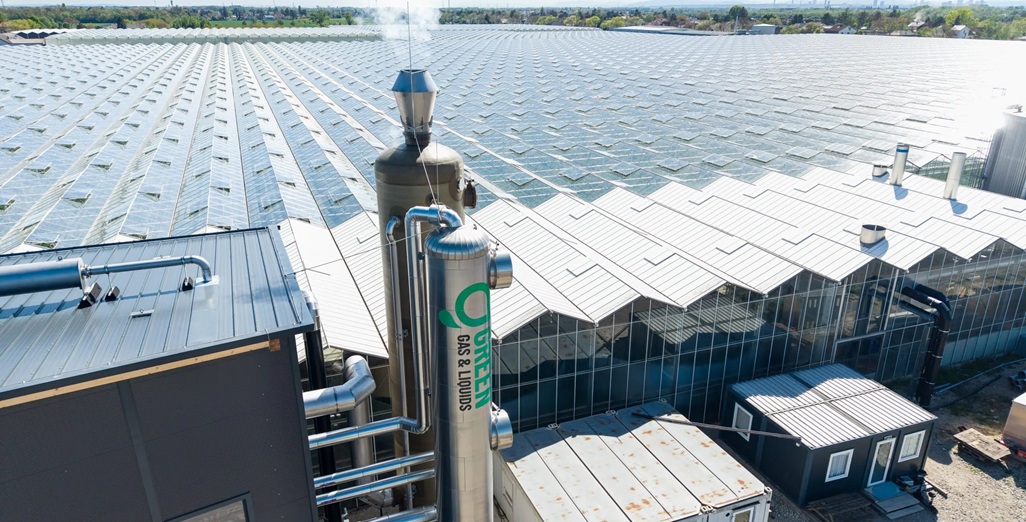
Greenhouse operators have wanted a local, sustainable CO₂ supply for years. The obstacle has always been the same: captured CO₂ needed liquefaction before it was safe to dose over a crop. That step is capital-intensive, energy-hungry, and mechanically complex. Green Gas & Liquids’ Galloxol® technology removes it. The system delivers CO₂ in gaseous form directly from the capture unit into the greenhouse.
An independent lab analysed CO₂ captured from a biomass boiler using Galloxol®. They tested it against ISBT and EIGA specifications. The measured gas met ISBT limits under real operating conditions — not in a laboratory. ISBT is a beverage specification, not a horticultural standard. Across most parameters it is considerably stricter. The result shows how little the Galloxol® process itself adds to the gas stream. Final CO₂ quality always depends on combustion method and fuel quality. But on a suitable fuel and a well-run boiler, the captured gas has met limits written for carbonated drinks.
A Safer Chemistry for Crop Enrichment
The solvent sits at the heart of Galloxol®. It captures CO₂ from flue gas. Unlike many amine-based systems, Galloxol® uses a solvent that is both safe and biodegradable. Amine systems often rely on chemicals that bring handling, toxicity, and disposal concerns. Galloxol® avoids those. This simplifies the compliance burden for plant operators. It also removes a source of chemical risk from CO₂ that enriches crops destined for consumption.
No Liquefaction Required
One technical feature defines Galloxol®: what it does not need. Conventional CO₂ production captures the gas, then liquefies it for purification, storage, and transport. That step demands significant electrical input for compressors and refrigeration.
Galloxol® delivers CO₂ suitable for crop enrichment directly in gaseous form. A greenhouse operator can pipe captured CO₂ straight into the growing environment. The gas never goes through liquefaction, cryogenic storage, or re-gasification. It moves from boiler exhaust to greenhouse in a single continuous process.
This marks the sharpest practical difference between Galloxol® and amine-based capture. Amine systems depend on liquefaction as the polishing step. That is where they separate out residual solvent carryover, degradation products, and other trace contaminants. Galloxol® does not need that step to produce gas fit for greenhouse use. Green Gas & Liquids supplies liquefaction where a project requires it — for buffering, storage, or off-site supply. But where the grower doses on-site, the liquefaction section can stay out of the plant entirely.
Lower Capital and Operating Costs Over the Plant’s Life
Removing liquefaction changes the economics. Liquefaction equipment represents a major capital line item. It also carries ongoing electricity costs because rotary compressors run continuously. The maintenance burden adds up — from routine servicing to eventual overhaul of rotating parts.
Galloxol® systems eliminate that step where on-site dosing makes it unnecessary. The design targets competitive capital and operating costs from the start and keeps them down over the plant’s operating life. Green Gas & Liquids sees this as what opens CO₂ capture to operators of all scales. It includes greenhouse businesses that a dedicated capture system might otherwise price out.
Operating Since 2019 — Proven, Not a Pilot
Galloxol® is not a newly commercialised concept. Green Gas & Liquids has run plants on this technology since 2019. Four systems operate today across the horticulture and biogas industries in the Netherlands, Italy, and Austria. The most recent installation serves a biogas upgrading site in Merschl, Austria. The Global CCS Institute also features the technology in its “State of the Art: CCS Technologies 2026” report.
What Greenhouse Operators Should Consider
Galloxol® combines three elements for growers evaluating their CO₂ supply options. First, a gaseous product they can dose straight onto the crop. Second, a safe and biodegradable capture chemistry. Third — where on-site dosing makes liquefaction unnecessary — materially lower capital and operating costs. On a suitable fuel and combustion regime, the captured CO₂ has shown itself clean enough to meet ISBT limits.
To discuss whether Galloxol® fits your greenhouse operation, contact our team at greengasliquids.com/contact.
CLASSIFIED









Photo
Gallery


Subscribe to our E-Zine
More
From This Category

September 22, 2026
New screens as a response to rising energy cost
"The cheapest energy ultimately remains the energy you do not need to purchase"
August 25, 2026
Why Are Growers Not Using the Geothermal Calculator?
A free tool has been developed specifically for New Zealand’s covered crop industry – so why aren't more growers using it?
August 11, 2026
CO₂ Capture for Greenhouses Without Liquefaction —
How Galloxol® Changes the Economics
July 14, 2026
More air movement, fewer gaps, more energy savings
"The major challenge in the energy transition is to continue growing healthy and vital crops with less energy"
June 1, 2026
A major milestone has been reached in Direct Air Capture and agriculture
Strategic alliance will establish a decentralized, fossil-free CO₂ supply for a vital greenhouse cluster in the Netherlands that spans 80 hectares
June 1, 2026
Phormium launches a new ultra-transparent energy screen: Diamond
The leading Belgian climate screen manufacturer Phormium announces the introduction of a brand-new revolutionary energy screen:
CLASSIFIED