
Sign up here to subscribe to the Grower2grower Ezine. Every two weeks you will receive new articles, specific to the protected cropping industry, informing you of industry news and events straight to your inbox.
14
Jul 2026
Jul 2026
More air movement, fewer gaps, more energy savings
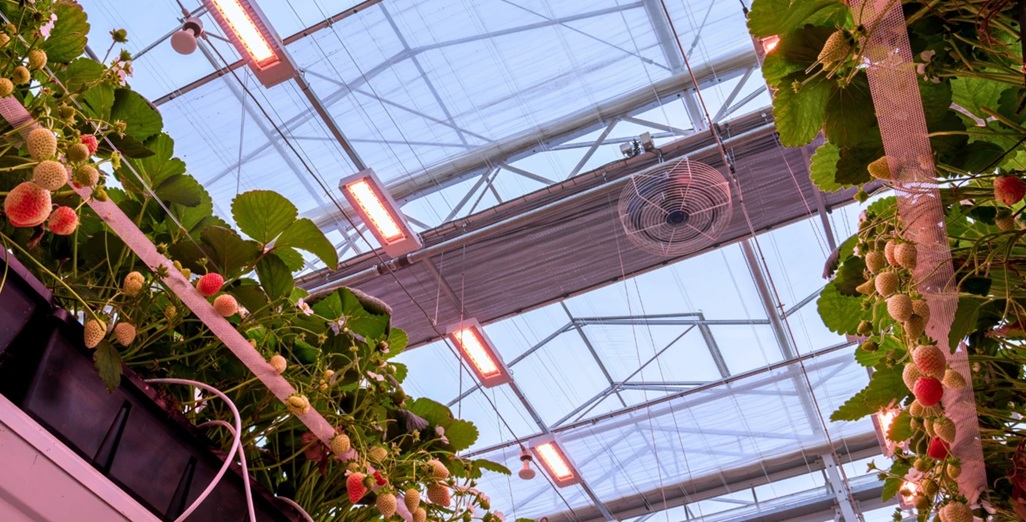
“The major challenge in the energy transition is to continue growing healthy and vital crops with less energy”
Vertical ventilation, in combination with a double screen, can lead to up to 20 percent additional energy savings, because growers can keep their screens and vents fully closed for more hours. “With thermal imaging cameras, we see that vertical ventilation combined with double screens and fewer gaps results in a much more homogeneous plant temperature between the top and the bottom,” says greenhouse climate expert Joris Vermonden of Svensson.
The major challenge in the energy transition is to continue growing healthy and vital crops with less energy. In the past, crop activity was typically activated by increasing the pipe temperature, but that heat is not getting cheaper, and the trend is that in the future – just like CO2 – it will only become more expensive. There is another way to introduce more air movement into the greenhouse, namely with the energy-efficient ClimaFlow ventilation system. In combination with a double screen, it offers growers the opportunity to open vents less frequently while maintaining vital plants.
From horizontal to vertical
Horizontal ventilation was traditionally used to resolve temperature inequalities in greenhouses, says Joris Vermonden. “This can be particularly useful in somewhat lower greenhouses, because they do not have very well-insulated facades or an uneven supply of heat via manifolds or ring mains. However, we have started building increasingly taller greenhouses and have maintained the practice of continuing to install horizontal fans. However, due to the height and distance of the airflow from the crop layer—that is, the evaporating and growing parts—a horizontal fan has little to no effect on the climate between the crops.”
Temperature differences in the greenhouse
There is roughly a 50 percent chance that horizontal ventilation does not contribute favorably to the natural airflow in a greenhouse, but actually exacerbates the imbalance. “They can be useful, however, if, for example, you need to distribute the active ingredient in a greenhouse as quickly as possible using a fogging device or LVM technique. Or if the heat output from the heating system is not super homogeneous. However: due to the height of modern greenhouses and the distance to the crop layer, the interaction with the microclimate between the crops is actually minimal, and that is why we mainly do this today using tube temperature.” Temperature differences in modern, well-insulated greenhouses are more likely to be caused by improper handling of screens, Vermonden continues. “By creating gaps in them or by using ventilation units that are not precisely matched to each other.”
Vertical ventilation
SON-T produces both light and heat, but has since been replaced by full-LED in many cases. “Because we introduce very little radiant heat into the greenhouse with LED, we have to supply the heat via another source or use more shading hours to better insulate the system. Again, we come to the point: crop activity, and thus moisture removal. Because the tubes usually hang at the bottom of the crop, an imbalance arises between the moisture content above and between the crop. We can manage this better by ventilating vertically. In this way, we can also cultivate with higher humidity without entering the danger zone regarding disease pressure and production.”
ClimaFlow
The VentilationJet of the ClimaFlow system draws in fresh air from above the closed screen, and the ClimaFlow Fan ensures that this air is immediately mixed, creating a light breeze through the crop. “In illuminated cultivation, we see that gaps are still left open too easily. Due to the moisture under the screen, there is a more frequent need to open gaps and ventilate, or to actively dehumidify. Both require a lot of energy to remove the moisture from the greenhouse. These are precisely the companies where we can really bring down the energy bill with less pipe heating and more airflow.”
Homogeneous plant temperature
Non-lit crops could potentially benefit even more from vertical ventilation, the greenhouse climate expert continues. “After all, the volume of a young tomato, bell pepper, or cucumber is not that large in winter, and the night period is also longer. We are quite successful at calculating the overall balance there. It also leads to some optimization of CO2 input, because less CO2 escapes to the outside and can reach the skin openings. With thermal imaging cameras, we see that vertical ventilation in combination with screens results in a much more homogeneous plant temperature between the top and the bottom.”
Energy savings of up to 20%
He continues: “In illuminated cultivation, the blackout curtain opens after sunrise, causing the plant temperature to drop if you do not compensate for this with a heat source. If we switch from the blackout curtain to a transparent energy screen in the morning, we can retain that heat, but physics dictates that the warmer air rises towards the screen fabric. With the vertical fan of our ClimaFlow system, you effectively push that heat back into the crop and limit vertical temperature differences. Because the power requirement of a fan is significantly lower than the energy consumption of a grow tube, this can save up to 20 percent extra energy. Where a 45-degree tube uses 47 W/m² to generate vertical air movement, our fan consumes less than 1 W/m² for vertical air movement. Calculate your savings.”
Quiet and economical
The advantage of ClimaFlow over other ventilation systems is that not only is power consumption very low and speed controllable depending on the humidity level in the greenhouse. “We are also very quiet, thanks to a super blade with a toothed structure, which results in lower energy consumption on the one hand and a more efficient airflow on the other. Our fan naturally makes some noise, but not to the extent that it is perceived as annoying. Quiet and energy-efficient due to the choice of materials (treated aluminum and stainless steel and the latest EC motors), making it horticultural-proof. And we have had CE certification since last year.”
Source
CLASSIFIED















Photo
Gallery







Subscribe to our E-Zine
More
From This Category
September 22, 2026
New screens as a response to rising energy cost
"The cheapest energy ultimately remains the energy you do not need to purchase"
August 25, 2026
Why Are Growers Not Using the Geothermal Calculator?
A free tool has been developed specifically for New Zealand’s covered crop industry – so why aren't more growers using it?
August 11, 2026
CO₂ Capture for Greenhouses Without Liquefaction —
How Galloxol® Changes the Economics
July 14, 2026
More air movement, fewer gaps, more energy savings
"The major challenge in the energy transition is to continue growing healthy and vital crops with less energy"
June 1, 2026
A major milestone has been reached in Direct Air Capture and agriculture
Strategic alliance will establish a decentralized, fossil-free CO₂ supply for a vital greenhouse cluster in the Netherlands that spans 80 hectares
June 1, 2026
Phormium launches a new ultra-transparent energy screen: Diamond
The leading Belgian climate screen manufacturer Phormium announces the introduction of a brand-new revolutionary energy screen:
CLASSIFIED