
Sign up here to subscribe to the Grower2grower Ezine. Every two weeks you will receive new articles, specific to the protected cropping industry, informing you of industry news and events straight to your inbox.
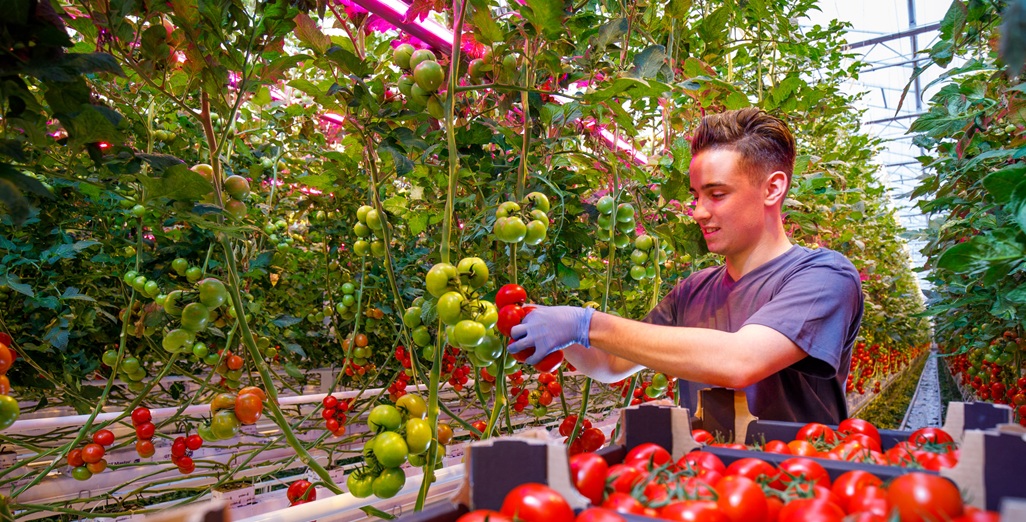
How LED intercanopy lighting complements high radiation and transforms greenhouse production
Optimizing greenhouse production with LED intercanopy lighting has become increasingly relevant, especially in environments characterized by high natural sunlight or strong supplemental toplighting. High-wire crops such as tomatoes often experience a rapid decrease in light levels toward the lower parts of the canopy. When abundant light is supplied from above, either naturally or through toplighting, further increasing upper illumination does not always yield additional benefits. This can result in saturation of the upper leaves while deeper layers receive insufficient light. The challenge is further amplified in lower greenhouse structures, where the proximity between fixtures and crops restricts the effectiveness of toplighting in penetrating the canopy and distributing light uniformly. Consequently, exclusive reliance on toplighting can lead to uneven plant development and reduced yield.
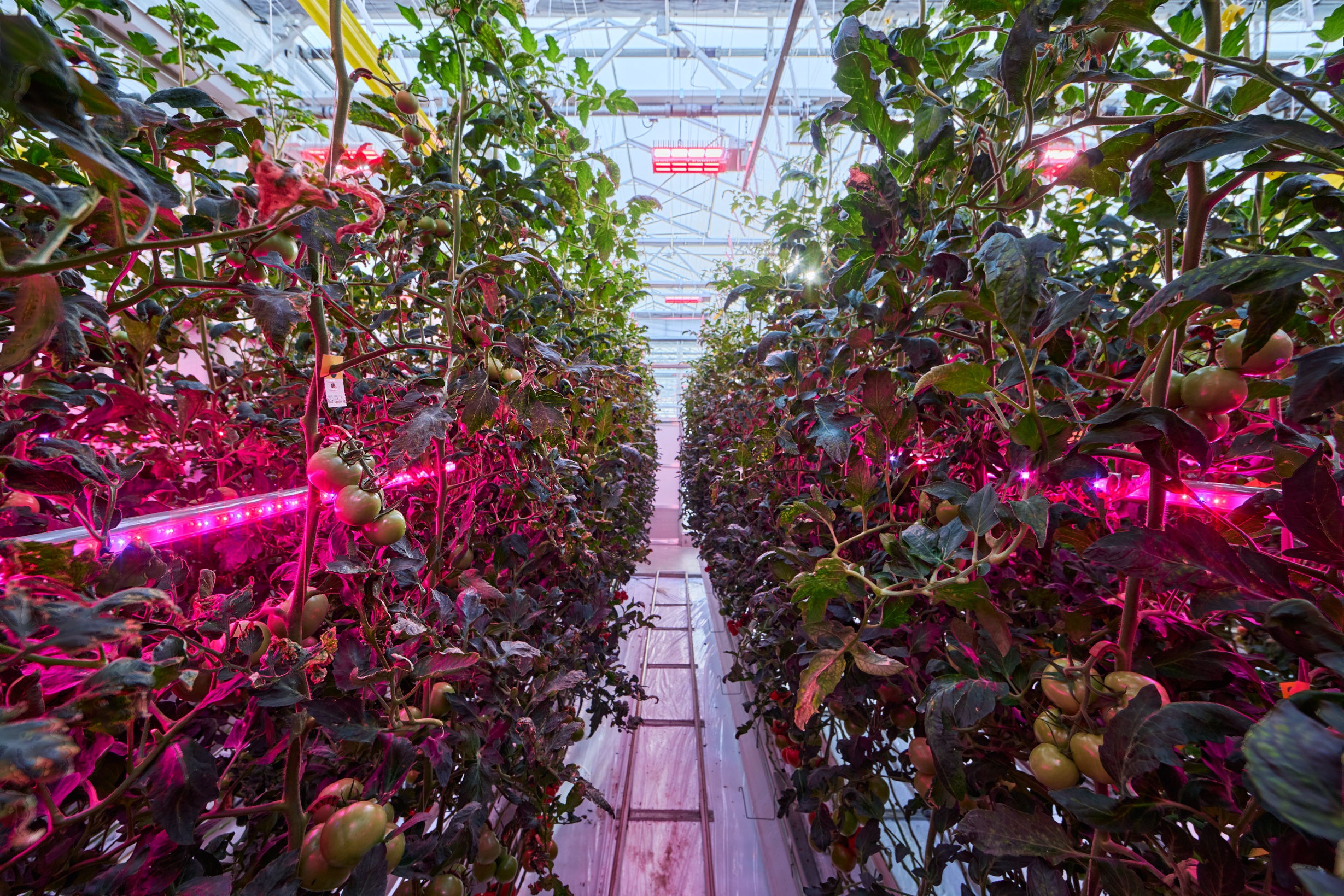
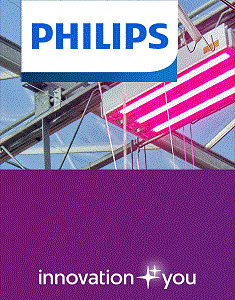
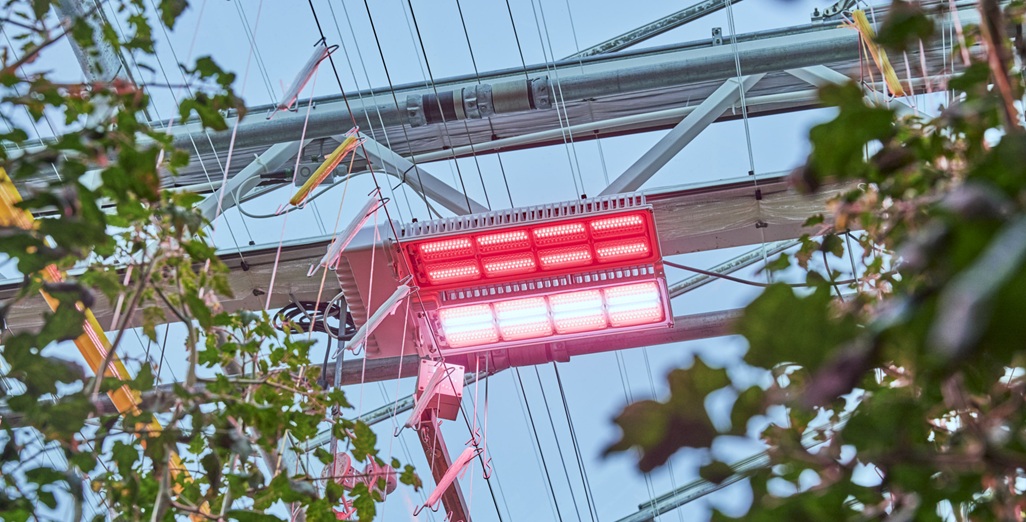
Philips LED interlighting addresses this issue by delivering light directly to the lower and middle sections of the crop canopy. This targeted approach ensures that all leaves, including those in shaded areas, receive adequate light for optimal growth, regardless of the intensity of sunlight or toplighting. Rather than expending energy on already saturated upper leaves, interlighting enhances conditions where they matter most for photosynthesis and plant health.
Adoption trends among growers
Growers in sun-rich regions are increasingly integrating LED intercanopy lighting to address the dual challenge of maximizing yield while avoiding crop overheating and upper-canopy saturation. This approach ensures uniform light distribution, increased plant biomass, and a balanced relationship between vegetative growth and fruit production. Its adaptability to various greenhouse structures and crop types makes it a valuable investment for those seeking high-quality produce and consistent output throughout the year.
Evidence from commercial greenhouses
Greenhouses in regions with benefit from abundant sunlight such as Mexico and certain parts in China, frequently encounter issues related to excessive heat or light at the upper canopy. LED intercanopy lighting mitigates these challenges by providing targeted illumination without increasing heat load, thereby enabling optimal use of natural and supplemental light sources. This technology has demonstrated notable results in countries like Japan, where tomato growers observed a 1.4% yield increase for each 1% of additional interlighting, with some reporting up to 25% higher yields compared to greenhouses lacking supplemental lighting.
Since its initial adoption in 2013, more than 20 Japanese tomato growers have implemented Philips GreenPower interlighting, attracted by its potential for increased yields. Growers employing single or double lines of interlighting at intensities of 55 or 110 μmol/m²/s have recorded substantial improvements in crop performance. The optimal photoperiod was identified as a maximum of 18 hours, extending LED usage from midnight until sunset. These strategies facilitate earlier achievement of optimal stem density and enhanced winter production, primarily due to more robust plant development.
The trend towards higher light intensities
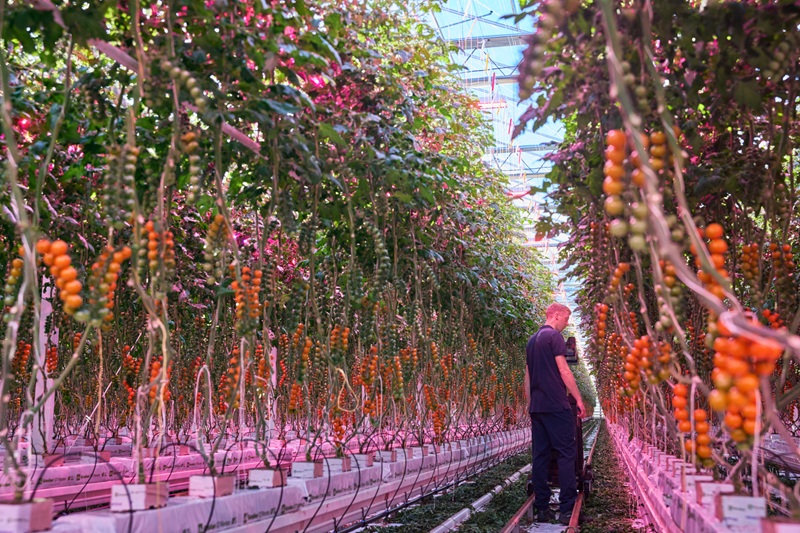
A recent trial* with high-wire cucumber and tomato found that increasing light intensity by adding intraconapy lighting to sunlight or toplighting, improved crop performance and yields by up to 24%. The trial clearly demonstrates that distributing light throughout the crop really pays off. The benefits of this approach become even more significant as the total amount of light increases. At higher light intensity (375 µmol), replacing part of the toplighting with intracanopy lighting led to an additional yield increase of 20–24%, compared to 10–12% at lower light intensity (250 µmol). This shows that smartly distributing light within the crop, especially under intense lighting, delivers a clear improvement in both yield and crop balance.
Summary of the benefits of LED intercanopy lighting
- Yield Enhancement Supported by Data: Each 1% increase in supplemental LED light may correspond to a 1+% rise in fruit yield, offering measurable improvements in profitability.
- Improved Produce Quality: The deep red and blue wavelengths used in LED systems are selected to optimize photosynthesis and energy efficiency. This results in robust plants and fruit that consistently meet high quality standards.
- Flexible Cultivation Management: In case a grower is not using supplemental lighting at the moment, LED interlighting allows for greater control over crop and climate conditions. This flexibility facilitates timely adjustments to cultivation schedules and supports consistent quality and yield throughout the year.
In short, LED intercanopy lighting represents a significant advancement in greenhouse cultivation. By improving light distribution within the crop canopy, it supports uniform plant development and higher yields, particularly in challenging high-radiation environments. As the technology continues to evolve, it offers growers a practical solution for optimizing production and maintaining competitive standards in the industry. By bringing light deeper into the canopy, overall production improves compared to using toplighting alone, under both moderate and high radiation levels.
For further information, please contact:
Philips horticulture LED solutions by Signify
Daniela Damoiseaux – Global Marcom Manager
For further information, please contact:
Philips horticulture LED solutions by Signify
Daniela Damoiseaux – global marcom manager
Tel: +316 40578311
E-mail:Daniela.damoiseaux@signify.com
About Signify
Signify (Euronext: LIGHT) is the world leader in lighting for professionals and consumers and lighting for the Internet of Things. Our Philips products, Interact connected lighting systems and data-enabled services, deliver business value and transform life in homes, buildings and public spaces. In 2021, we had sales of EUR 6.9 billion, approximately 37,000 employees and a presence in over 70 countries. We unlock the extraordinary potential of light for brighter lives and a better world. We achieved carbon neutrality in 2020, have been in the Dow Jones Sustainability World Index since our IPO for six consecutive years and were named Industry Leader in 2017, 2018 and 2019. News from Signify is located at the Newsroom, Twitter, LinkedIn and Instagram. Information for investors can be found on the Investor Relations page.
New Zealand – Australian Contact:
Aart Slobbe
Account Manager Horticulture LED Solutions
+ 61 448 881 338
Email aart.slobbe@signify.com
Suite 022, 44 Lakeview Drive
Scoresby, VIC 3179, Australia

About Signify
Signify (Euronext: LIGHT) is the world leader in lighting for professionals and consumers and lighting for the Internet of Things. Our Philips products, Interact connected lighting systems and data-enabled services, deliver business value and transform life in homes, buildings and public spaces. With 2020 sales of EUR 6.5 billion, we have approximately 38,000 employees and are present in over 70 countries. We unlock the extraordinary potential of light with smart lighting solutions that improve quality of life, and by working towards a sustainable future. We became a carbon-neutral company in 2020, since our stock market listing, we have been in the Dow Jones Sustainability World Index for four years in a row and were named Industry Leader in 2017, 2018 and 2019. News from Signify is located at the Newsroom, Twitter, LinkedIn and Instagram. Information for investors can be found on the Investor Relations page.
For all media releases please send to marie@grower2grower.co.nz or upload directly: https://www.grower2grower.co.nz/article-form/
CLASSIFIED






Photo
Gallery




Subscribe to our E-Zine
More
From This Category
July 27, 2026
GrowWise smart spectrum helps growers save energy or boost crop growth through automated spectrum optimization
“With just a few clicks, we achieved approximately 2% more light on the crop”
July 13, 2026
Philips LED lighting enables precise winter growing at Truly Green Farms (Canada)
For Truly Green Farms, winter tomato production depends on having the right lighting system in place.
June 29, 2026
How stone wool and lighting can change the game for strawberry growers
An ever- higher number of strawberry growers are discovering the benefits of Controlled Environment Agriculture
June 29, 2026
Are your LEDs ready for the future?
How can you stay in control as lighting becomes more complex?
June 15, 2026
Signify expands Philips GreenPower LED toplighting force portfolio with tailored solutions for today’s diverse grower strategies
New Performance and Elite versions empower growers to optimize either upfront investment or long-term operational efficiency—without compromising on Philips quality
June 1, 2026
Signify: Developing next-generation cultivation systems that shorten growing cycles while maintaining consistent crop quality
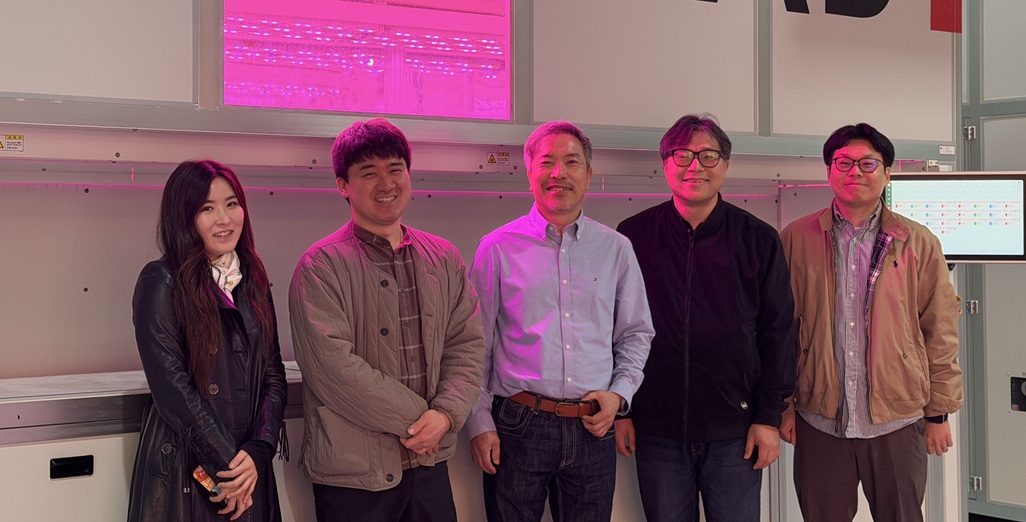
Signify boosts crop productivity and cost competitiveness at Yonam University smart farming hub with intelligent Philips LED lighting
CLASSIFIED